
Introduction
Kajabi is widely used by course creators, coaches and consultants, along with other businesses that sell knowledge online. Instead of running your website in one place and your courses or marketing somewhere else, you can handle most of that work from one account.
As a business grows, that can make day-to-day work easier because there are fewer systems and connections to manage. Still, Kajabi is not right for everyone, especially if you only need one or two simple features.
Before choosing a plan, it is worth looking at the Kajabi Pros and Cons in practical terms. What matters is how many of its features your business will actually use.
Kajabi Pros and Cons: Quick Answer
Kajabi is a strong option for businesses selling courses, coaching programmes, memberships or other digital products that want their website, marketing and sales activity connected. Its main drawback is cost. Kajabi explains that its pricing is higher than many single-purpose tools because it is designed to replace several services.
In simple words:
- Kajabi makes sense when several built-in tools replace separate subscriptions.
- It may feel expensive if you only need straightforward course hosting.
- It suits digital and knowledge-based businesses better than physical-product shops.
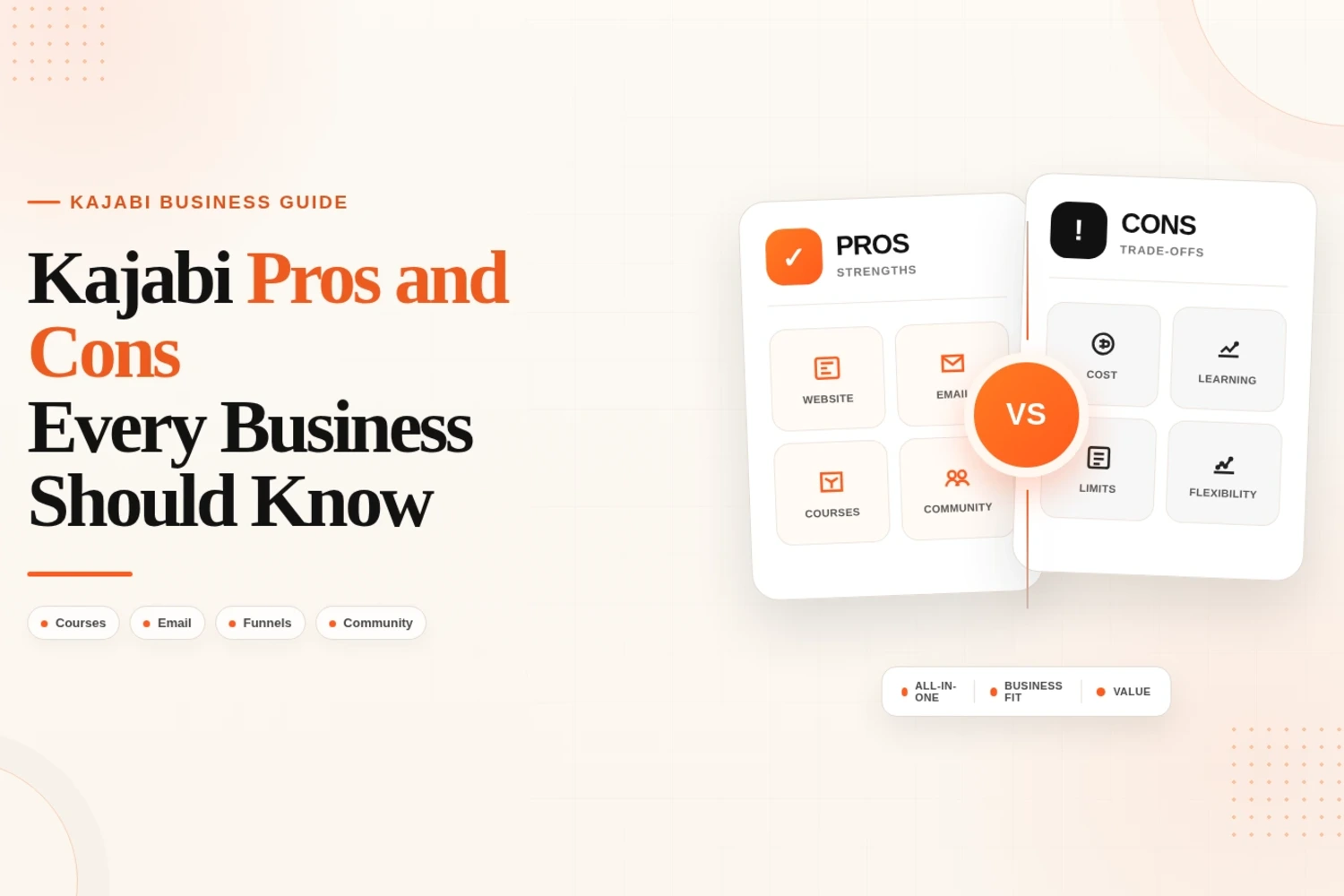
Kajabi Pros and Cons at a Glance
| Kajabi Pros | Kajabi Cons |
|---|---|
| Website, products and marketing in one platform | Can be costly for a new or smaller business |
| Built-in email marketing | Takes time to learn the wider system |
| Supports courses, coaching and memberships | Plans include limits on products and contacts |
| Funnels and automation are included | Highly custom website design may need extra work |
| Checkout, upsells and order bumps | Specialist software may offer deeper features |
| Customer information stays connected | Can be more than you need for one simple course |
| Community features are built in | Not mainly designed for physical ecommerce |
| Fewer separate platforms to manage | Moving an existing setup needs planning |
Quick takeaway: The biggest advantage is convenience. Kajabi can reduce the number of tools you rely on but a simple business may still pay for features it rarely uses.
What Are the Main Pros of Kajabi?
1. You Can Manage More of Your Business in One Place
This is one of the clearest reasons businesses choose Kajabi. Your website can sit alongside your courses, coaching offers and memberships, while landing pages and customer records are managed there too. That means less jumping between dashboards and fewer integrations to look after.
2. Marketing Tools Are Already Built In
Kajabi is more than somewhere to upload lessons. You can build landing pages, collect leads and send email campaigns without another marketing platform. Automated sequences and sales funnels can guide people from their first sign-up towards a paid offer.
3. You Can Sell More Than Online Courses
A business does not have to stay focused on one course forever. Kajabi gives you room to add different digital offers over time.
You can also use it for:
- Coaching programmes
- Memberships
- Communities
- Digital products
- Newsletters
- Podcasts
You might start with a course, add coaching later and introduce a paid membership as your audience grows. It can all remain within the same platform.
4. Sales Tools Work With Your Products
Kajabi connects your products with the tools used to sell them. Customers can pay once, subscribe or use a payment plan, with upsells, downsells and order bumps available too. A purchase can then trigger access or start the relevant email sequence automatically.
5. Email and Customer Information Stay Connected
Because customer activity and email marketing live in the same platform, follow-up can reflect what people actually do. Someone who has bought from you can receive different messages from a person who only joined your mailing list, without constantly moving data between systems.
6. Community Can Sit Alongside Your Products
Kajabi also has built-in Communities for coaching groups, memberships or courses that need ongoing discussion. Customers can ask questions, take part in challenges and stay involved between lessons, without moving between unrelated platforms.
What Are the Main Cons of Kajabi?
Kajabi covers a lot but there are still drawbacks to think about before signing up. Cost, learning time and actual need are the main ones.
1. Kajabi Can Feel Expensive
Price is usually the first concern. Kajabi costs more than many course-only platforms because it is intended to replace several services. That can suit an established business already paying for separate tools but it may feel excessive for someone launching a first small course.
2. There Is Still a Learning Curve
Kajabi is built for non-technical users but there is still plenty to learn. Products, Offers, Funnels and Automations have different roles, while Contacts and Email Campaigns have their own areas. You do not need coding skills, though independent user reviews also commonly mention the initial learning curve.
3. Your Plan Has Limits
Kajabi plans set different limits for products, contacts, websites, communities and admin users. The current Basic plan, for example, allows fewer products and contacts than higher tiers. A business with a large audience or several offers should check those limits before moving.
4. Website Design Has Some Limits
You can build a full website and landing pages in Kajabi without writing code, which is enough for many businesses. An unusual layout or very specific brand experience may still need custom code or professional Kajabi design work.
5. It May Not Replace Every Specialist Tool
Kajabi does a lot but it will not be the strongest option in every area. Complex email requirements may still call for specialist marketing software, while some businesses need advanced learning or ecommerce features. When weighing up the Kajabi Pros and Cons, ask whether it has enough of the right features for your business.
Who Is Kajabi Best For?
Kajabi is best suited to businesses that make money from knowledge, expertise or digital content. It becomes more useful when you need more than a basic place to upload videos and want the rest of the customer journey to connect with what you sell.
It works particularly well for:
- Course creators
- Coaches
- Consultants
- Educators
- Membership businesses
- Experts selling digital products
- Personal brands
- Businesses selling several online offers
Kajabi itself positions the platform around coaches, educators, creators, consultants and other experts building a business around what they know. If your website, marketing and sales process need to work closely with your products, the platform starts to make much more sense.
Who May Not Need Kajabi?
Kajabi is not automatically the best choice for every online business. A simpler platform may be enough when your setup is small or when you already have tools that work well for you.
You may want something simpler if:
- You only want to sell one basic course
- You have a very small budget
- You already have marketing tools you are happy with
- You only need a simple website
- You mainly sell physical products
- You need very advanced learning or training features
For someone testing a first idea, paying for a complete business platform may not make sense yet. On the other hand, a business already paying for separate website, email, course, funnel and community tools may get far more value from bringing those jobs together.
Is Kajabi Worth It for a Business?
Kajabi can be worth the money when you genuinely use several parts of the platform. If it replaces your course software, website builder, email service, funnel tool and community platform, the monthly price looks very different from the cost of a simple course host. This is where the Kajabi Pros and Cons become a cost comparison rather than a feature checklist.
Kajabi's pricing is built around this all-in-one approach and the company says it does not take a percentage of business revenue, although normal payment processing fees still apply. If you only need one simple feature, a smaller platform will usually cost less.
So instead of asking only "Is Kajabi expensive?", ask "How many of my current business tools could Kajabi replace?" That usually gives you a clearer answer because you are comparing Kajabi with your real setup, not one isolated tool.
Conclusion
Kajabi has plenty going for it when several parts of an online business need to work together. Its biggest strength is not one feature but the way products, marketing and customer activity can sit in the same system.
The trade-off is cost and a learning curve. A very small business may not need everything Kajabi includes, while a growing business may get much more value from the same subscription.
For coaches, course creators, consultants and membership businesses, the Kajabi Pros and Cons often become easier to balance once more of the platform is being used. Choose Kajabi because it solves real problems in your business, not because the feature list looks impressive.
FAQs
What are the biggest advantages of Kajabi?
Kajabi lets you manage course delivery, website content, marketing and customer activity from one platform. This can reduce the number of separate systems a digital business needs to maintain.
What is the biggest disadvantage of Kajabi?
For many smaller businesses, the biggest drawback is price. It can be difficult to justify if you only need one or two parts of the platform.
Is Kajabi good for small businesses?
Yes, especially for businesses selling courses, coaching, memberships or digital products. Very small businesses with simple needs may prefer a lower-cost option at first.
Is Kajabi difficult to use?
Kajabi does not require advanced technical skills but there is a learning curve. Most users need time to understand how Products, Offers, Emails, Funnels and Automations work together.
Can Kajabi replace a website?
Yes. Kajabi includes tools for building a full website and landing pages, so many knowledge-based businesses can use it as their main site.
Is Kajabi worth the money?
It can be if you use several built-in tools. If you only need straightforward course hosting, a simpler platform may offer better value.
What types of businesses are best for Kajabi?
Kajabi is best suited to course creators, coaches, consultants, educators, membership businesses and other experts selling knowledge or digital products online.
Need Help Getting More From Kajabi?
We build custom Kajabi websites, courses, funnels, integrations and sales experiences around the way your business actually works. The aim is to make the platform fit your process rather than forcing your business into a standard setup.
Build My Kajabi Website